Table Linen Guide
How Tablecloth Drop Changes the Look and Fit of a Dining Table
A tablecloth does more than cover a tabletop. The fabric that falls past its edge frames the table, changes the room’s proportions and can determine whether dinner feels easy or awkward. Measure first; then choose a drop suited to the way the table is used.
There is a small but consequential decision behind nearly every dressed dining table: how far should the cloth hang? A narrow border of fabric can feel informal and practical. A longer fall lends ceremony, softens the table’s hard outline and gives a room a more composed appearance. Neither is automatically better. The right tablecloth drop depends on the table’s dimensions, its shape, the chairs around it and the kind of meal taking place.
Getting the fit right begins with a tape measure, not a guess about what looks generous in a product listing. The tabletop is only half the calculation. The cloth must also fall evenly, clear laps and chair seats, and leave enough room for people to sit down and get up comfortably. A few minutes of measuring can prevent a cloth that looks skimpy, sweeps the floor or catches on every chair.
This guide explains how to measure for rectangular, square and round tables, how to calculate tablecloth measurements, and how different drops influence the mood and function of a setting. The aim is not to impose a rule on every home. It is to make the choice deliberate.
What “tablecloth drop” means
The drop is the distance the fabric extends vertically from the edge of the tabletop. If a table is 30 inches high and the cloth hangs 10 inches below its edge, the drop is 10 inches. The cloth’s total dimensions are larger than the tabletop because they include the fabric that falls on each side.
For a rectangular or square table, the drop is added twice to each tabletop dimension: once for each opposite edge. For example, a 60-by-36-inch tabletop with a 10-inch drop calls for a cloth approximately 80 by 56 inches. The calculation is straightforward:
- Cloth length: tabletop length + twice the desired drop.
- Cloth width: tabletop width + twice the desired drop.
The same principle applies to a round table. Add twice the desired drop to the tabletop diameter. A 48-inch round table with a 10-inch drop needs a cloth about 68 inches in diameter. These figures are starting points; the finished result may vary slightly because of hems, fabric behavior and how precisely the table itself measures.
Do not confuse the drop with the cloth’s overall size. A tablecloth listing may give the full length and width, not the amount that hangs over the edge. To find the drop from a rectangular cloth, subtract the table dimension from the corresponding cloth dimension and divide by two. If a 90-inch-long cloth is placed on a 70-inch-long table, the drop at each end is 10 inches.
Measure the table before choosing a size
Measure the tabletop at its widest and longest points. For a rectangular table, record both length and width. For a square table, measure one side, then check the adjoining side rather than assuming they match. For a round table, measure straight across the center to find the diameter. If the table has leaves, measure it in the configuration in which the cloth will most often be used. A cloth sized for the smaller setting may not cover the expanded surface.
Tables are not always perfect geometric shapes. An oval table, for example, has a length and width like a rectangle, but its curved ends affect how the fabric hangs. A cloth made for an oval tabletop is designed to follow that outline; a rectangular cloth may work, but its corners can extend farther and create a different silhouette. For unusual shapes, use the maker’s sizing guidance and, if possible, test the dimensions with a sheet or other spare fabric before purchasing.
Also measure the table height and note the height of the chair seats. Standard dining tables often stand around 28 to 30 inches tall, but actual furniture varies. That difference matters. A 12-inch drop on a taller table may finish well above the floor, while the same drop on a lower table can approach a seated diner’s knees. If the table has an apron or frame beneath the top, account for it too: fabric may brush against the apron even when the visible drop seems modest.
When measuring, keep the tape level and start at the tabletop edge rather than from underneath a rounded lip. If the edge is curved, decide whether you want the cloth to begin falling at the outermost point or sit slightly farther in. Small details can change the way a cloth lies, especially on a table with a thick or shaped edge.
Choosing a drop for everyday dining
Everyday meals ask for a cloth that looks finished without interfering with the ordinary choreography of dinner: chairs sliding in, children reaching for a glass, plates moving across the surface. A drop of about 8 to 12 inches is a useful starting range for many home dining tables. It gives the fabric enough length to soften the table’s edges while usually keeping it clear of laps and chair seats.
A shorter drop, roughly 6 to 8 inches, can be particularly practical in a busy kitchen or breakfast nook. It leaves more of the table’s legs visible and reduces the chance of fabric being pulled, stepped on or caught when someone shifts a chair. The result is casual and direct. It can also suit a small room where a large curtain of fabric would make the furniture feel heavier.
For a family table used for homework, quick meals and crafts as well as dinner, practicality may matter more than convention. A cloth that can be moved aside easily is more likely to be used. Consider whether corners will fall within a child’s reach, whether the fabric might catch on chair arms, and whether people often pass through a narrow space around the table.
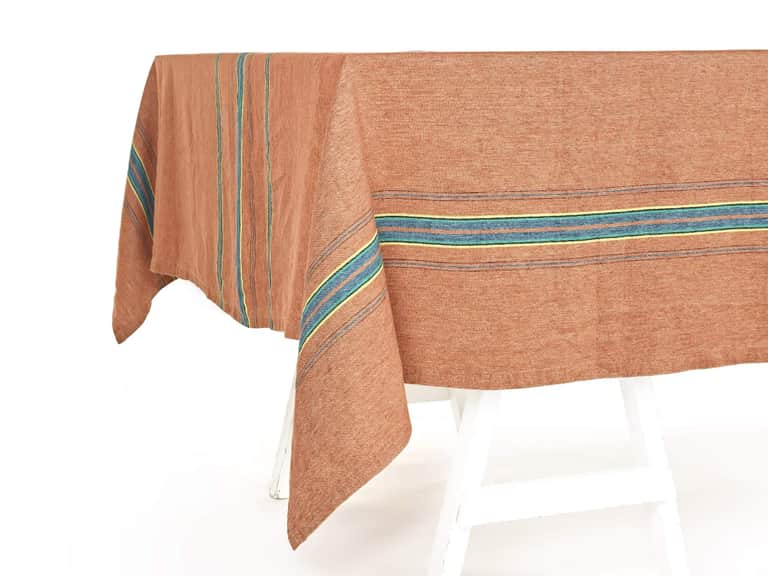
Texture and weight influence the practical effect. A soft, lightweight cloth can shift more readily than a heavier one, while a crisp fabric may hold a clear line at the edge. Linen tends to have a natural, relaxed character, and its appearance can feel at home in both everyday and more considered settings. For instance, The Ontario Stripe Tablecloth is made from stonewashed Belgian linen in a herringbone weave. Its stripe pattern and textured finish bring visual character to a table, though the correct size still depends on the tabletop and the drop you want.
A longer drop changes the room
When a setting calls for a more formal impression, a longer drop can make a decisive difference. A fall of about 15 to 18 inches is often used for occasions that benefit from a fuller, more dressed appearance. The cloth conceals more of the table’s legs and brings the eye down from the tabletop, giving the setting a sense of occasion.
That visual effect is not merely decorative. A longer drop can make a small or simple table feel more substantial, and it can help unify a room by covering mismatched table legs or a surface that is not part of the intended look. But a cloth that hangs too low can undermine the polish it was meant to create. It may brush against diners, interfere with chairs or invite a foot to catch the hem.
A floor-length drop is a distinct choice, usually associated with formal events, display tables or settings where chairs will not be pulled close to the edge. To estimate it, measure from the tabletop edge to the point where you want the cloth to end. If the table is 30 inches high and the cloth should finish about an inch above the floor, the desired drop is approximately 29 inches. Add twice that drop to the tabletop dimensions to estimate the cloth size.
Before committing to a near-floor length, consider the room in use. A hem that looks elegant in an empty dining room can become a hazard when guests move around the table. Children and pets add another practical consideration. Long fabric can be tugged, stepped on or caught under a chair. Formal does not have to mean impractical; a slightly shorter drop can preserve the composed look while making the setting easier to navigate.
How shape affects the fit
Rectangular tables
Rectangular tables are the simplest to size: measure the length and width, then add twice the intended drop to each. But the two directions need not produce the same visual impression. A long table may be surrounded by chairs at both sides and ends, so check clearance all around. On an extendable table, confirm whether the cloth is for the closed or expanded length. A cloth that fits the table without its leaves may leave exposed sections when the table is opened.
Square tables
For a square table, the same drop applies on every side, and the cloth should usually be square. Measure both sides and use the same calculation for length and width. A cloth that is slightly off-square may produce noticeably uneven corners, especially on a small table. If the table sits against a wall, you may choose to prioritize the visible sides, but equal overhang remains the most balanced option when the table is accessible from all directions.
Round tables
On a round table, the cloth’s diameter determines the drop around the entire circumference. Add twice the desired drop to the tabletop diameter. A round cloth creates an even fall when correctly centered, but the placement deserves attention: a small shift to one side makes the drop appear uneven all around. Smooth the cloth from the center outward and check the distance at several points before setting the table.
Round tables can also make a long drop feel more pronounced because the fabric forms a continuous curved edge. A modest drop often keeps the look light, while a longer one emphasizes the table’s outline. Think about where chair backs and legs sit in relation to the cloth, not just the tabletop diameter.
Oval and irregular tables
Oval tables combine a long axis with curved ends, so a rectangular measurement alone does not fully describe the fit. A rectangular cloth may be suitable for a casual setting, but the fabric can extend farther at the corners than along the sides. A cloth cut for an oval shape follows the edge more closely. For an irregular or pedestal table, check whether the base affects chair placement; a long drop can conceal the base, but it should not obstruct knees or movement.
Chair clearance is part of the measurement
A tablecloth may be the right size on paper and still feel wrong once people sit down. Before choosing a drop, pull the chairs out and push them in as diners would. Check whether the fabric catches on a chair back, hangs over the seat or lies where knees will press against it. With armchairs, measure the distance from the tabletop to the highest point of the arms. A generous drop can meet the arms and bunch rather than fall cleanly.
Leave enough space for a chair to move freely. The cloth should not be trapped between the table and the chair or drag across the seat when someone stands. In a tight dining area, a shorter drop can make circulation easier. In a room with ample clearance, a longer one may be comfortable, provided it does not interfere with the table’s base or diners’ legs.
Think about the table’s apron, the structural panel beneath the tabletop, as well. If the cloth is meant to hang over the apron, its effective visible drop begins at the tabletop edge, but its physical path may be interrupted by the frame. A thick apron can push fabric outward or make it sit unevenly. This is another reason to test a proposed cloth length on the actual table whenever possible.
Fabric, pattern and the perceived drop
The same measurement can look different in different materials. A heavier cloth tends to fall with a more defined line; a lighter one may move with air or settle in soft folds. Linen’s texture and drape can lend a relaxed finish, while a smooth, crisp fabric may make the edge look sharper. A hem adds a little weight and structure at the bottom, and a generous border or fringe can make the drop appear longer than its measurement suggests.
Pattern affects the eye, too. Stripes running across a cloth can emphasize the table’s width; stripes running lengthwise can make a rectangular setting feel more elongated. A border near the hem draws attention to the cloth’s edge, making an uneven drop easier to notice. In contrast, an all-over pattern may soften small irregularities. These are visual tendencies, not strict rules, but they matter when the cloth is a central part of the room.
Care and laundering can also affect fit over time. Follow the maker’s instructions, particularly for natural fibers, and check whether the stated dimensions are finished measurements. Some fabrics may change slightly after washing. If a tablecloth is close to the minimum size you need, even modest shrinkage could shorten the drop. When exact sizing matters, use care guidance and product measurements as part of the decision rather than treating them as afterthoughts.
Tablecloth, runner or layered setting?
A tablecloth is not the only way to bring fabric to a tabletop. A runner covers a narrower strip down the center, leaving much of the table visible. It can be useful when the table’s surface is worth showing, when a full cloth feels too formal, or when diners need a clear place for serving dishes. A runner does not create a tablecloth drop around the perimeter; its overhang at the ends is a separate styling choice.
For a layered look, a runner can sit over a tablecloth, but the combination works best when each layer has a clear purpose. A short runner on a full cloth may define the center and introduce contrast. A long runner may extend beyond the ends of the table, creating a second kind of drape. Keep the layers from interfering with plates, serving bowls or the movement of chairs.
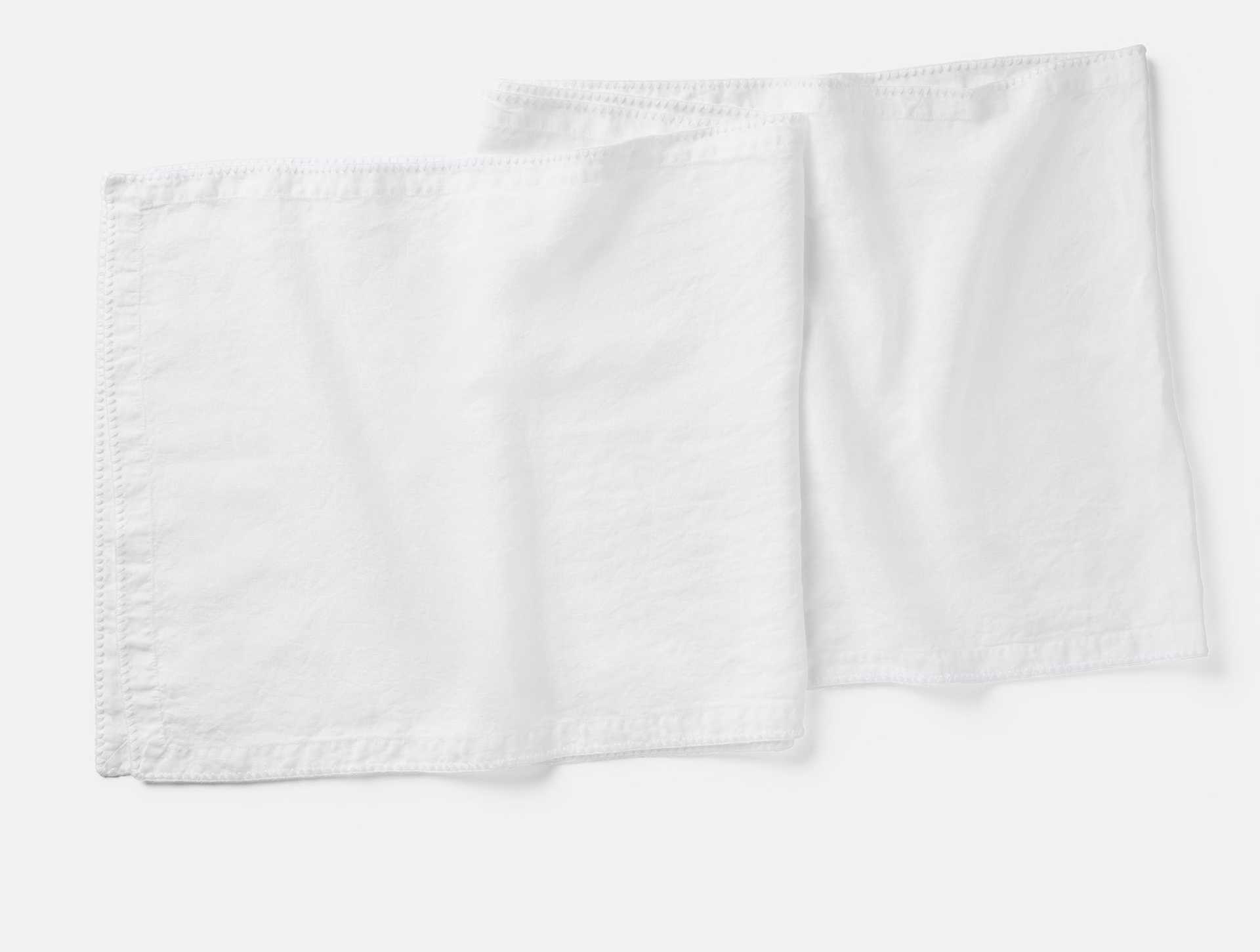
One option in this category is the Olivos Embroidered Organic Linen Runner, made from organic linen with shell-stitch embroidery. Its dimensions and end placement should be considered separately from a full tablecloth: it is a center layer, not a substitute for calculating the cloth’s drop on every side.
A quick method for selecting the right fit
- Measure the tabletop. Record length and width for rectangular or square tables, and diameter for round ones. Measure the table in the configuration you plan to cover.
- Choose the use. Decide whether the cloth is for everyday meals, a special gathering or a formal display. Consider children, pets and the available space around the chairs.
- Select a drop. Use a shorter fall for a casual, low-interference setting; choose a moderate drop for a balanced everyday look; consider a longer fall when you want a more formal effect and have room for it.
- Calculate the cloth size. Add twice the desired drop to each tabletop dimension. For a round table, add twice the drop to the diameter.
- Check the furniture. Compare the expected hem position with the chair seats, chair arms, apron and floor. Make sure the cloth will not impede sitting or movement.
- Confirm the finished measurements. Read the product dimensions and care instructions, and allow for the possibility that laundering may affect the fabric.
A useful final test is to mark the intended drop with a measuring tape or a strip of fabric while standing beside the table. Sit down and pull a chair in. The tabletop view may suggest one answer; the experience of using the table may suggest another. Both matter.
Common tablecloth sizing mistakes
- Measuring only the tabletop. The overhang must be included on both sides of each dimension.
- Assuming a listed size is the drop. Most dimensions refer to the whole cloth. Subtract the table size and divide by two to find the overhang.
- Ignoring chair clearance. A dramatic fall can catch on seats, arms or legs, even when the calculation is correct.
- Forgetting table extensions. A cloth for the closed table may not cover it when leaves are added.
- Expecting an oval fit from a rectangle. A rectangular cloth can work, but corners may hang differently from the curved ends of an oval tabletop.
- Choosing a floor-length drop without testing it. The cloth may look graceful when the room is empty and become inconvenient once chairs move.
- Overlooking fabric behavior. Weight, weave, hems and care requirements all influence how a cloth hangs and whether it retains its original dimensions.
The right drop is the one the table can live with
Tablecloth sizing is a small exercise in proportion. The right drop can make a table feel more welcoming, soften a room or turn an ordinary meal into a considered occasion. The wrong one can leave diners negotiating with fabric instead of enjoying dinner. That is why the best choice begins with accurate tablecloth measurements and ends with a practical test in the room where the table is used.
For many households, a moderate drop offers the most adaptable balance: enough fabric to give the table a finished outline, not so much that chairs and knees become part of the styling problem. A shorter cloth can make daily life easier; a longer one can set a more formal tone. The table’s shape determines the calculation, but the household determines the answer.
Measure the top, calculate the overhang, and look at the space from a seated position. Then choose a cloth whose fabric, dimensions and drop suit the occasion as well as the furniture. A table is meant to be used. Its linen should make that use feel a little more considered, without getting in the way.